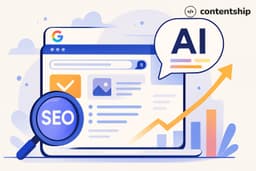
Search used to be a list of ten blue links. Now, more sessions start with an answer box written by an AI system, then a handful of sources underneath it. In that world, ranking is still valuable, but it is no longer the whole game. If your content is not selected as a source, you can be visible in the SERP and still be absent from the actual decision-making moment.
That is why automated SEO is changing shape. The point is not to automate writing. The point is to automate the operational work that makes content eligible to rank and eligible to be cited. In practice, that means tighter topic coverage, clearer information architecture, better sourcing, and consistent refresh cycles that keep pages current as the market and the SERP move.
This shift is not theoretical. ChatGPT reached 100 million users in record time, which tells you how quickly user behavior can move once a new interface becomes mainstream. That matters because the interface determines the incentives, and the incentive in AI search is to be used as evidence.
The New Visibility Problem: You Compete to Be Part of the Answer
In traditional SEO, the competition is obvious. You fight for position one, you improve CTR, you expand your snippet. In generative search, the competition is quieter. You are competing to be included in a synthesis.
The practical difference is this. A page can be “good enough” to rank in the top ten, but still be a bad candidate for citation because it is vague, unsourced, or hard to extract. AI systems tend to reward content that can be confidently quoted, summarized, and cross-validated.
This is why GEO and SEO are converging into one workflow. You still need search-friendly pages, but you also need citation-friendly pages.
Curious how often AI cites your content? See an AI visibility snapshot on Contentship.
How Automated SEO Works in an AI-Answer World
Automation is useful when the task is repetitive, rules-based, and easy to validate. That describes a lot of modern search work, especially the parts that teams keep postponing because they are tedious.
A solid automated SEO loop looks like four connected systems.
First, you need discovery automation. That means continuously pulling in what changed in your category, what competitors published, what your users ask in forums or support tickets, and what keywords are gaining traction. If discovery is manual, you end up publishing in batches, and you are always late.
Second, you need production automation, but with governance. The workflow should generate intent-aligned briefs, outlines, and drafts that are grounded in SERP reality. The draft is not the deliverable. The deliverable is a publish-ready unit that includes internal links, structured sections that can be cited, and the assets needed for distribution.
Third, you need distribution automation. If the content only ships to the blog, you are leaving citations on the table. Generative systems often pull from places where the conversation happens. In many verticals that includes community and UGC platforms, so syndication formats and repurposing matter.
Fourth, you need refresh automation. In AI search, freshness is not just a ranking factor. It is a trust signal. Outdated pages get skipped, even when they were once authoritative.
Google has been explicit that succeeding in AI-powered search still depends on publishing helpful, reliable, people-first content, plus making it accessible and technically crawlable. That guidance is worth treating as the baseline spec, not an optional best practice. The most direct reference is Google’s own guidance on creating helpful content and their notes on succeeding in AI search.
What Actually Gets Cited: The Patterns We See Repeatedly
The uncomfortable truth is that most content is written to be read by a human. That sounds fine, until you realize AI systems have to parse, chunk, and extract it first.
Content tends to get cited when it does a few things consistently.
It states claims clearly, then supports them. When your key takeaway is buried in a long intro or wrapped in soft language, it is hard to quote. Strong pages put the core idea early, then expand.
It uses numbers, quotes, and explicit sourcing. One research direction in GEO has found that adding statistics and quotes can materially improve visibility in generative answers. The paper often referenced here is GEO: Generative Engine Optimization (arXiv:2311.09735). Even if you do not treat early GEO studies as gospel, the pattern matches what we see in the field. Evidence-rich content is easier to trust and easier to cite.
It is written in extractable sections. AI systems love pages that have crisp headings, short paragraphs, and self-contained explanations. If you have a “what it is”, a “when it works”, and a “how to do it” section, you are giving the model clean building blocks.
It is accessible. If your content relies heavily on client-side rendering, you can end up invisible to crawlers that do not execute JavaScript well. In a world where AI bots and search bots do not behave identically, we push teams to keep the critical content server-rendered or at least reliably indexable.
It matches the query intent tightly. This is still SEO 101, but it becomes more important in AI answers because the model is trying to satisfy a user question directly. If your page meanders, it becomes a worse candidate for synthesis.
Key Benefits: What You Get When You Automate the Right Things
When teams say they want automated SEO, they often mean “publish more.” The benefit is not volume. The benefit is consistency.
You get a repeatable way to cover a topic cluster without gaps. That is how you build the association between your brand and the subject area, which increases both rankings and citation probability over time.
You reduce the operational drag that slows content down. Every article has hidden work. Briefing, editing, optimization, uploading, internal linking, repurposing, and tracking take real hours. If those steps are not systematized, you cannot scale without burning out your strategist.
You get faster feedback loops. When discovery, publishing, and monitoring are connected, you can see what is moving in weeks, not quarters. That matters because AI features and SERPs are volatile right now.
Getting Started: A Practical Automated SEO Workflow for GEO
If you are an SEO strategist at a small or mid-sized company, the constraint is usually bandwidth, not ideas. So the workflow below is designed to be implementable without a huge team.
Step 1: Define What You Want to Be Cited For
Pick 3 to 5 themes that are directly tied to your product’s value. This is not generic top-of-funnel. It is the set of problems you want AI assistants to associate with you when users ask for recommendations or explanations.
Then map those themes into a small set of page types. Usually that is a mix of guides, comparisons, troubleshooting, and glossary-style explainers.
Step 2: Automate Discovery and Opportunity Scoring
Set up a weekly cadence that pulls:
- keyword movements and new variations
- competitor publishing and internal linking patterns
- recurring questions from sales calls and support
The goal is not to collect everything. It is to continuously prioritize what to publish next, using simple scoring like traffic potential, conversion relevance, and SERP difficulty.
Step 3: Systematize the Brief So the Draft Is Predictable
A good brief forces alignment before writing. It should lock the target intent, primary angle, must-include entities, sources to cite, and the internal pages you should link to.
If you do this well, the draft becomes easier to QA. More importantly, it becomes easier to refresh later because you know what the page is supposed to do.
Step 4: Publish With Extraction in Mind
Before you hit publish, scan for a few citation blockers.
If the introduction takes 400 words to make a point, tighten it.
If your claims are not backed by a source, either add the source or remove the claim.
If the page has no scannable structure, add headings that mirror the user’s questions.
Step 5: Build a Refresh Loop
Set a refresh interval based on the topic. For fast-moving categories, that could be monthly. For stable concepts, quarterly is often enough.
A refresh loop should check whether the SERP changed, whether the page still matches intent, whether better sources exist, and whether internal links need to be updated as your site grows.
Automated SEO Optimization: What to Automate vs. What to Keep Human
Automating the wrong parts creates the classic failure mode. You publish a lot. Nothing ranks. Then you blame the model or the algorithm.
In practice, you can safely automate:
- SERP and competitor monitoring
- deduplication and similarity checks so you do not cannibalize yourself
- outline generation that is constrained by intent and structure
- metadata suggestions and internal link opportunities
- distribution formatting for social and newsletters
- monitoring and alerts when rankings shift
You should keep human judgment for:
- the decision of what to be known for
- the angle that differentiates you in a crowded SERP
- the sourcing standard. what evidence is credible in your industry
- final QA for accuracy, tone, and product truth
This is also where “using AI for SEO” becomes real. It is not a magic trick. It is leverage applied to the operational steps that usually steal your week.
Choosing an Automated SEO Tool Without Falling Into the DIY Trap
Most teams evaluate an automated SEO tool by asking, “does it generate content?” That is the wrong question.
The right question is whether the system covers the work around the article, and whether it stays maintained as platforms change. A DIY setup can look cheap because building is the visible part, but the maintenance and quality governance is where time disappears.
If you do compare vendors, keep the comparison focused on operations. Does it include research, briefs, QA gates, internal links, distribution formats, and refresh workflows. Or does it just output a draft.
If you want a quick overview of how we think about replacing tool sprawl, our comparison hub lays out the difference between content tools and content operating systems.
Measuring Success: Rankings, Citations, and Share of Voice
In this new search environment, you need two scoreboards.
The first is the classic SEO view. rankings, clicks, impressions, and conversions.
The second is AI visibility. How often are you mentioned or cited in ChatGPT, Gemini, Perplexity, and AI Overviews for the prompts that matter to your category.
Google has stated that AI Overviews have expanded to a massive user base. Alphabet reported that AI Overviews reach about 1.5 billion monthly users. That scale makes it rational to track AI visibility alongside rankings, because even small citation share can influence a lot of buying journeys. The primary source is Alphabet’s Q1 2025 earnings call materials.
Conclusion: Automated SEO Is Now About Building Citation-Ready Content
Automated SEO used to mean saving time on repetitive tasks. It still does, but now the bar is higher. You are optimizing for two outcomes at once. You need to rank in Google, and you need to be selected as a source inside AI-generated answers.
If you treat GEO as a separate discipline, you will likely duplicate work and miss the operational bottlenecks that slow you down. If you treat it as the next iteration of SEO, and you automate the workflows around discovery, production, distribution, and refresh, you end up with content that is both ranking-ready and citation-ready.
If you are trying to make automated SEO sustainable without hiring a whole team, it can help to work from a system that already bakes in research, governance, and refresh cycles. We built Contentship to run that end-to-end content engine so your strategy turns into consistent shipping, plus the quality signals that help you rank and get cited.
FAQs
What Is Automated SEO in 2026?
Automated SEO is the use of workflows and tooling to reduce repetitive SEO operations like discovery, briefing, on-page checks, internal linking suggestions, distribution formatting, and refresh monitoring. The goal is consistency and speed, not hands-off publishing. In AI-driven search, it also supports building citation-ready pages.
How Is GEO Different From Traditional SEO?
SEO focuses on ranking in search results and earning clicks. GEO focuses on being included in AI-generated answers as a cited or referenced source. In practice, the fundamentals overlap heavily, but GEO raises the importance of extractable structure, strong sourcing, and keeping content fresh.
What Should I Automate First for SEO Using AI?
Start with discovery and prioritization, because that determines everything downstream. Then automate repeatable QA checks like keyword and entity coverage, duplication detection, and internal linking suggestions. Keep human review for positioning, accuracy, and source quality so you do not scale mistakes.
Do AI Assistants Prefer Certain Content Formats?
They tend to cite content that is easy to extract and verify. That usually means clear headings, short self-contained sections, direct answers, and support from statistics or credible sources. Pages that hide the point or rely on vague claims are harder to use in a synthesized answer.
How Can Contentship Help With Automated SEO Without Just Being an AI Writing Tool?
We focus on the workflow around the draft. research, intent-aligned structure, QA gates, internal linking, distribution formats, and refresh linking so content stays current. That operational layer is what turns “using AI for SEO” into a repeatable engine instead of a batch of one-off articles.